
By Zaigam Akhtar
What if firearms looked like rectangular slabs of paper, firing ideas instead of bullets?
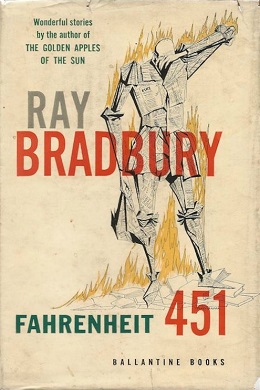
This is the world that Ray Bradbury paints in his seminal dystopian fiction novel — Fahrenheit 451. Of course, that’s a metaphor for Books — the most dangerous thing in this authoritarian world.
In this future, books are banned. Reading is a lost action of the past, and possessing books is a crime punishable by death. But when you read between the lines, you see that books are not the actual threat, it’s Ideas!
Guy Montag, the protagonist, is a fireman in this story. Firemen now are called not to put out fires but to burn books, people who possess them, and their homes.
One evening Montag meets a rebellious young girl named Clarisse. She tells him things that Montag keeps in his subconscious but can’t seem to form meaningful thoughts out of. Even if he did, he was afraid to face the consequences. Because things like free will, self-expression, and curiosity are dead, or more specifically, killed by the authoritarian regime.
“Trust the authority and ask no questions” is the motto that’ll keep you safe and alive. But humans are curious creatures and thus Montag starts questioning the sanity of it all. This leads him to a path of self-discovery and a fiery face-off (pun intended) with Captain Beatty, who’s the head of the fire department.
Fire has a strong emphasis in this world. So much so, that those in power use literal flamethrowers to burn people! The author encapsulates this chilling reality with the line — “It was a pleasure to burn. It was a special pleasure to see things eaten, to see things blackened and changed.” — Ray Bradbury
Fahrenheit 451 — “the temperature at which book-paper catches fire, and burns.”.
The accuracy of this statement has been questioned time and again. Yet the book’s impact hasn’t been diminished by this minor flaw.
The book depicts the perilous edge of independent thought and serves as a cautionary tale about a society complicit in its destruction. Ultimately, Montag discovers the immense challenge of resistance when there is nothing left to cling to. And also that ideas are indestructible.

My Reading Experience
I’m gonna be honest here. I found it pretty hard to finish this book. At the back of my head, I know it’s a highly acclaimed classic. However, the writing felt pretty sophisticated to me, not in the use of language but in the way the ideas are conveyed.
For instance, the book has multiple accounts where the characters repeat certain words incessantly. I found it confusing, as to why the author chose to do that. Upon some research, I understood that it’s intentional —
It’s an attempt to emphasize the far-fetched eradication of culture and creativity. It’s to the point where people have to change the way they talk to put across their point to others with diminished attention spans. (Ring a bell?)
Here’s how Beatty describes the proliferation of mass culture to Montag:
“Speed up the film, Montag, quick. Click? Pic? Look, Eye, Now, Flick, Here, There, Swift, Pace, Up, Down, In, Out, Why, How, Who, What, Where, Eh? Uh! Bang! Smack! Wallop, Bing, Bong, Boom! Digest-digests, digest-digest-digests. Politics? One column, two sentences, a headline! Then, in mid-air, all vanishes!”
Though this may have worked in favor of the story. For the not-so-avid reader, like me, it started to feel a bit discombobulating. Or maybe I’m just a lazy reader.
That said, I did enjoy the latter part of the book and I found the characters fascinating, especially Clarisse and Captain Beatty.
I guess this is one of those books that require multiple readings to grasp the ideas it’s trying to serve fully. Perhaps, someday I’ll return to re-read this masterpiece of sci-fi dystopia.
Until then, Keep reading and keep asking questions!